
When the Cloth Is Part of the Palette
Most stitchers meet florals on pale linen or open Aida, where every petal sits on light. Dark-ground work asks a different question: how do roses, leaves, and star accents stay luminous when the fabric itself is teal, bronze, chocolate, or deep olive?
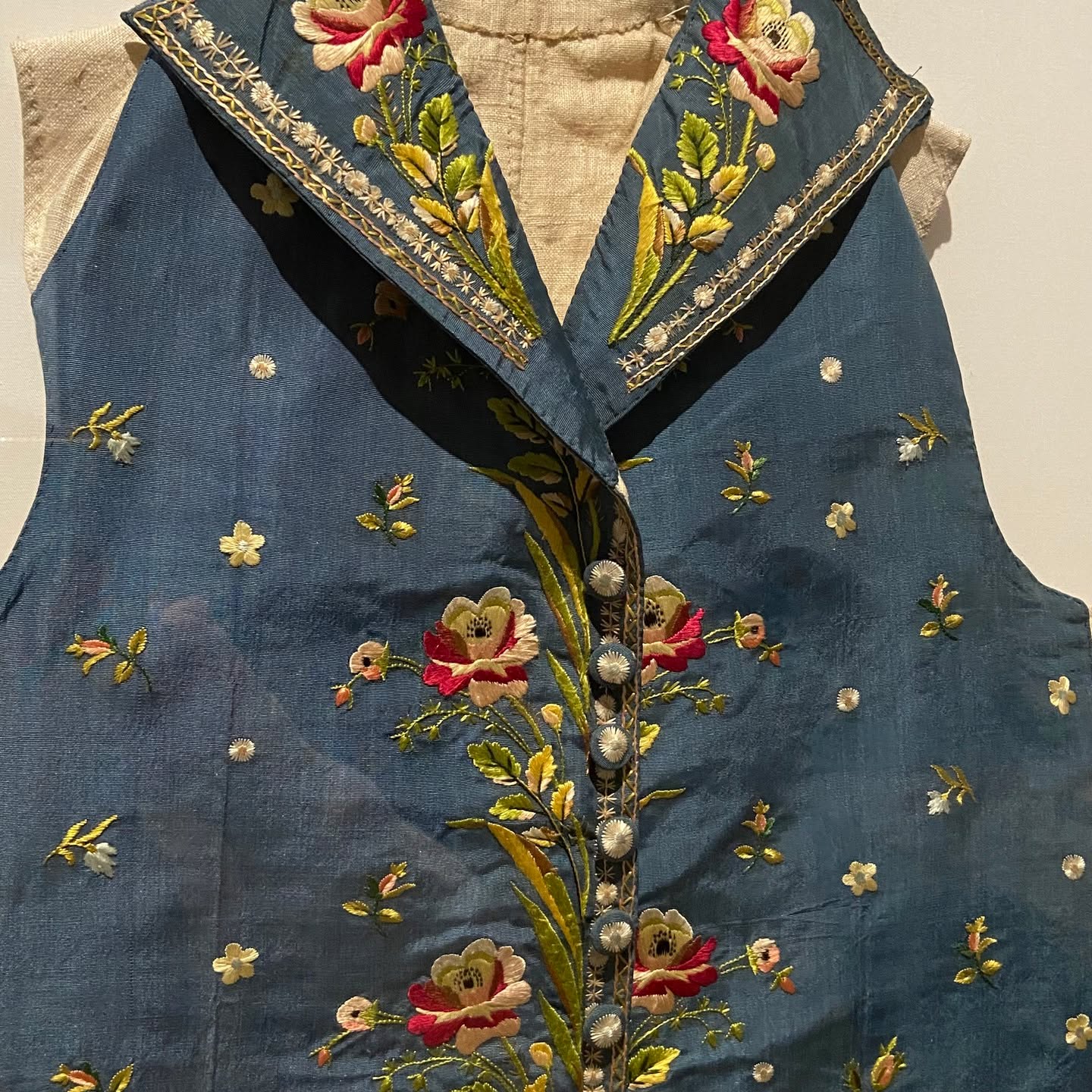
The answer is not more color—it is clearer structure. Historical waistcoats and tailored panels show the same grammar again and again: dense sprays that rise from openings—plackets, buttonholes, pocket flaps—thin punctuation across open fields, and borders that frame the eye without crowding it.
COSMO® No. 25 Embroidery Floss—extra-long staple cotton in over 500 solids, with a polished soft sheen—is built for that kind of control. Separate strands for fine stems; keep fuller strands for satin petals that catch light effectively off a dark weave.
Why a Dark Ground Changes Everything
Dark-ground habits
On white cloth, mid-tones do much of the work. On a dark ground, mid-tones disappear and only the lightest and brightest solids read as bloom. That is why cream-to-crimson roses and chartreuse leaves feel so alive on teal silk: they are chosen to outshine the cloth, not blend into it.
Think of the fabric as your darkest “thread.” Then choose a short solid palette—often 5–8 colors—that climbs clearly above that floor. A quick check: lay candidate skeins on the dark cloth and photograph them in grayscale on your phone—if a color disappears in black-and-white, it lacks the value contrast to pop.
- Test candidate solids on a scrap of the same dark cloth before filling a large spray
- Snap a grayscale phone photo of skeins on the fabric—colors that vanish in monochrome need a higher-contrast swap
- Keep one near-white or pale cream for petal highlights and French-knot stars
- Reserve the deepest reds and olives for shadow—never as the only petal color
- Let empty ground breathe between sprays so the cloth remains part of the design
The Spray: A Motif Built for Openings
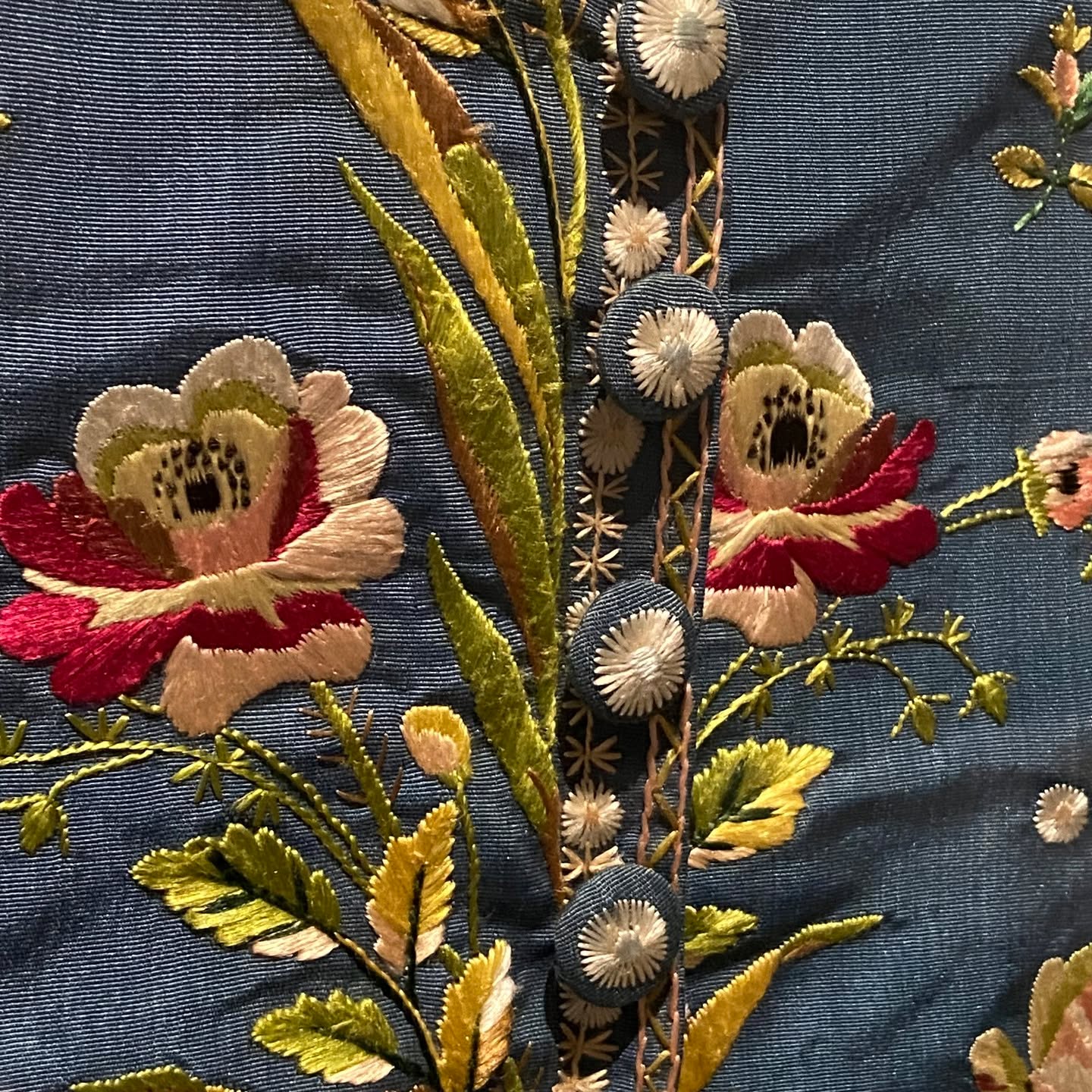
A classic spray grows from a placket, pocket edge, or collar point and fans outward. It is not a centered bouquet. The stem line often follows the garment’s architecture—buttons, bound edges, or a vertical vine—so embroidery and construction feel inseparable.
Work the largest blossoms first where light should land, then add elongated leaves, then the smallest buds and star dots that scatter into open cloth.
Quiet Grounds, Quiet Accents
Not every structured panel needs jewel contrast. Olive-bronze and chocolate grounds favor cream, white, and soft gold—florals that feel like light falling on cloth rather than paint on a dark canvas.
Here, COSMO® Nishikiito® Metallic Thread earns a sparing role: a sunburst on a covered button, a thin border glint, or a single pollen spark. Across its 33 specialty colors and five finishes—Kagami, Opali, Fuji, Champagne, and Classic—one metallic note on dark silk reads farther than a field of glitter.
Designing for Panels, Not Pictures
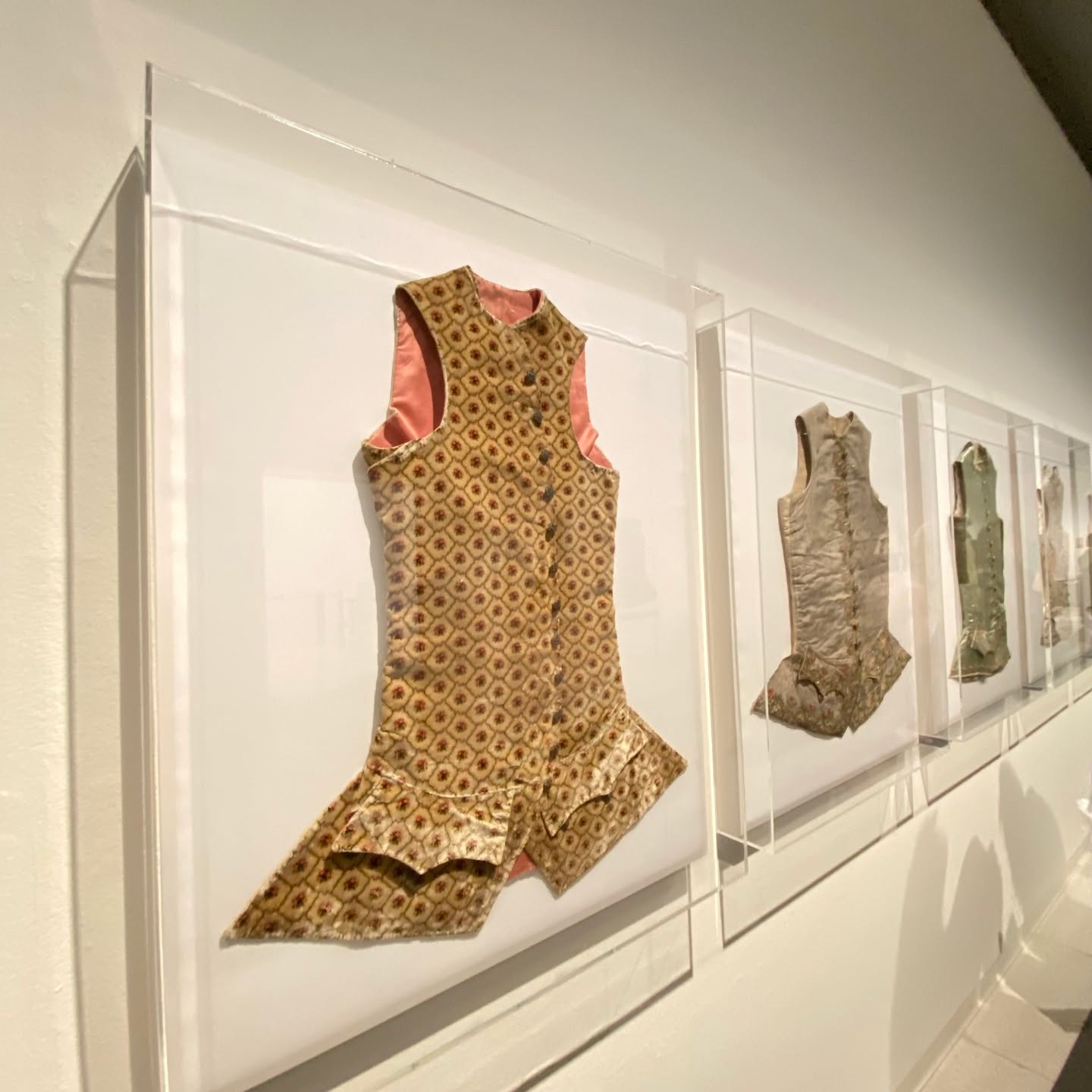
Structured cloth—waistcoat fronts, jacket panels, firm linen facings—divides space into zones: collar, chest, placket, pocket flap, hem. Embroidery that respects those zones looks intentional; embroidery that ignores them looks stuck on.
Before the first stitch, name the zones you will decorate and the zones you will leave bare. Symmetry across a center opening is powerful; so is a single asymmetric spray when the opposite panel stays quiet.
Stitch Choices That Hold on Dense Cloth
Practical notes
Satin and long-and-short stitches build petal volume; stem or outline stitches keep vines thin enough to travel. French knots and tiny star stitches become the “air” between larger forms—especially useful for scattering light across dark fields.
On tightly woven silk, tailored wool, or heavy structured linen, needle choice matters as much as strand count. A sharp, slim Crewel or Milliners needle in sizes 7–10 pierces the weave cleanly and is less likely to leave permanent puncture marks if a stitch must be unpicked. Pair that with gentle tension so highlights stay on the surface instead of sinking into the cloth.
Transfer is the other dark-ground friction point: lightboxes and blue water-soluble pens often fail on teal, bronze, or chocolate fabric. Use white dressmaker’s carbon, white chalk transfer, or a water-soluble stick-and-stitch stabilizer topper so spray outlines stay visible until you cover them with thread.
- Match strand count to scale—fewer strands for fine vines; more for satin roses that must catch light
- Prefer a size 7–9 Crewel needle on structured silks or dense wools
- Transfer spray outlines with white carbon, chalk, or a stick-and-stitch topper before filling
- Echo button and border colors in tiny accents so hardware and stitch feel related
- Optional: one Seasons strand in foliage only when you want soft leaf movement—keep petals in solids so blooms stay crisp
Tips for Dark-Ground Florals
A short checklist keeps dense work from becoming muddy.
- Test values in monochrome — snap a grayscale photo of your chosen No. 25 skeins resting on the dark fabric; if a color disappears in black-and-white, swap it for a higher-contrast tint before stitching.
- Transfer with care — use white dressmaker’s carbon or a water-soluble stabilizer topper to transfer spray outlines clearly onto dark teal, bronze, or chocolate grounds.
- Choose sharp, slim needles — use a size 7–9 Crewel needle on structured silks or dense wools to avoid leaving permanent puncture marks in the fabric weave.
- Anchor sprays to openings — align sprays with button lines, plackets, or border edges rather than floating bouquets in open space.
- Punctuate with Nishikiito® — keep metallics to single-strand highlights—button details, pollen sparks, or narrow border accents—so they catch light without overpowering the floral work.
Product Recommendations
Build sprays with solids for clarity; reserve metallics and variegation for deliberate accents. The charts below show the real ranges—so you can picture petal lights, one metallic catch, and soft foliage shifts before you buy.
- COSMO® No. 25 Cotton Floss — over 500 solid colors of extra-long staple cotton with a polished soft sheen that reflects light effectively off dark grounds.
- COSMO® Nishikiito® Metallic Thread — 33 specialty colors across five finishes (Kagami, Opali, Fuji, Champagne, Classic); use sparingly on buttons, borders, or pollen highlights.
- COSMO® Seasons Variegated Floss — 140 self-shading colors; optional soft shifts in foliage only—keep primary blooms in solids so sprays stay sharp.
Final Note
Dark-ground florals are less about recreating a garment and more about learning a visual language: sprays that grow from structure, lights that outshine the cloth, and quiet fields that let dense work breathe.
With a short COSMO® No. 25 palette—and one metallic note when the panel asks for it—structured cloth becomes a stage where every blossom can hold its light.