
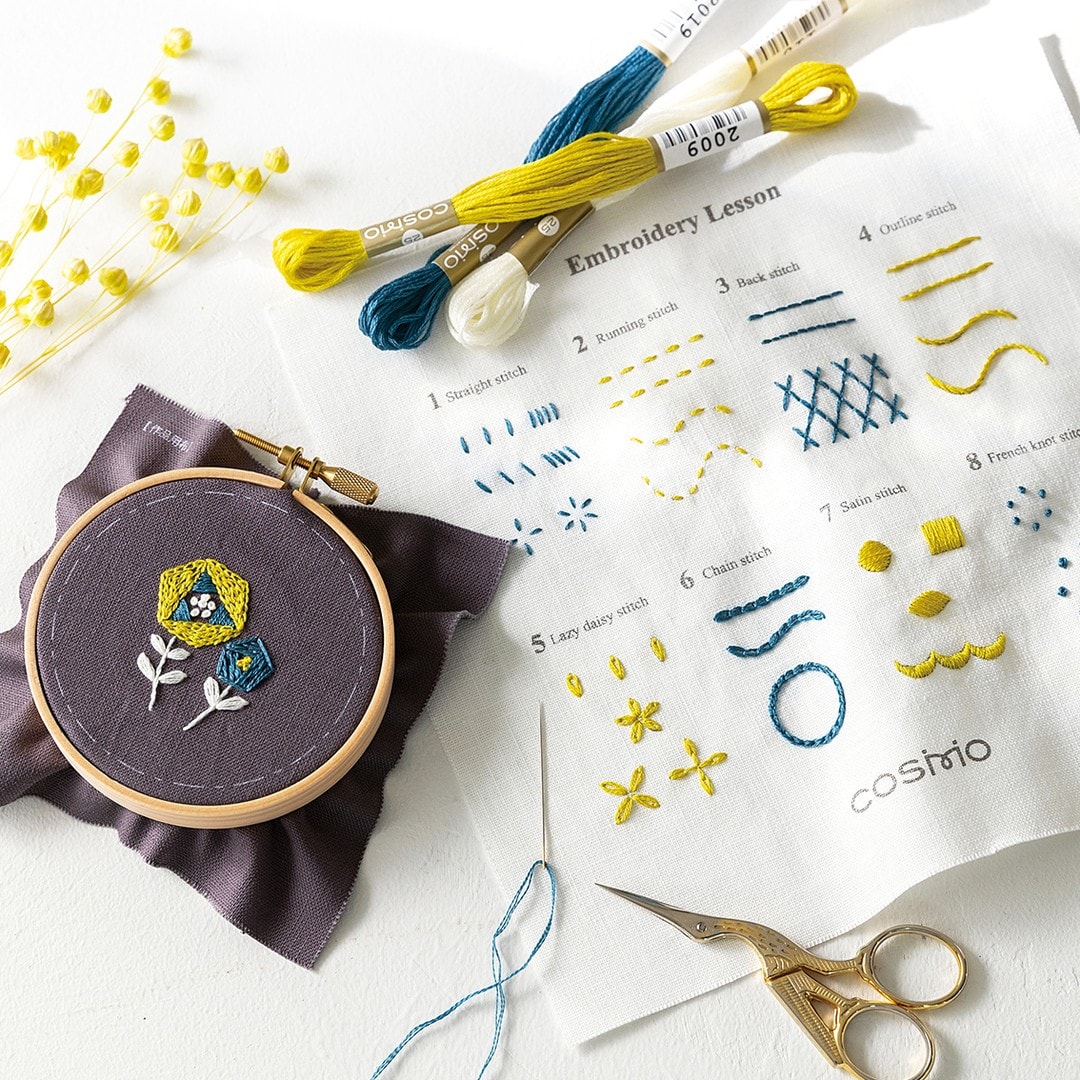
Learn the Basics, Create Something Beautiful
Embroidery begins with the simplest motions. A single line, a tiny knot, a looping curve—mastered one stitch at a time, these movements build the foundation for work you can wear, gift, or hang. COSMO threads give you a clear alphabet to practice: from a quiet sampler to a small finished motif.
Start with a calm kit and a short palette. Three complementary No. 25 shades—cream, teal, and yellow—teach control, tension, and consistency without distraction.
A Calm Kit to Begin
Keep the first palette small
A lesson cloth, a few skeins, needles, and a wooden hoop are enough. The point is not to own every color—it is to see each stitch clearly.
- COSMO® No. 25 solids in cream, teal, and yellow (or a similar quiet trio)
- A medium-weight lesson cloth so stitch structure stays visible
- A 4–6 inch wooden hoop and embroidery needles (often sizes 5–7)
The Eight Essential Stitches
What each stitch does
Each stitch has a job—drawing a line, filling a shape, or adding texture. Work them on one lesson cloth so the page becomes a reference you keep.
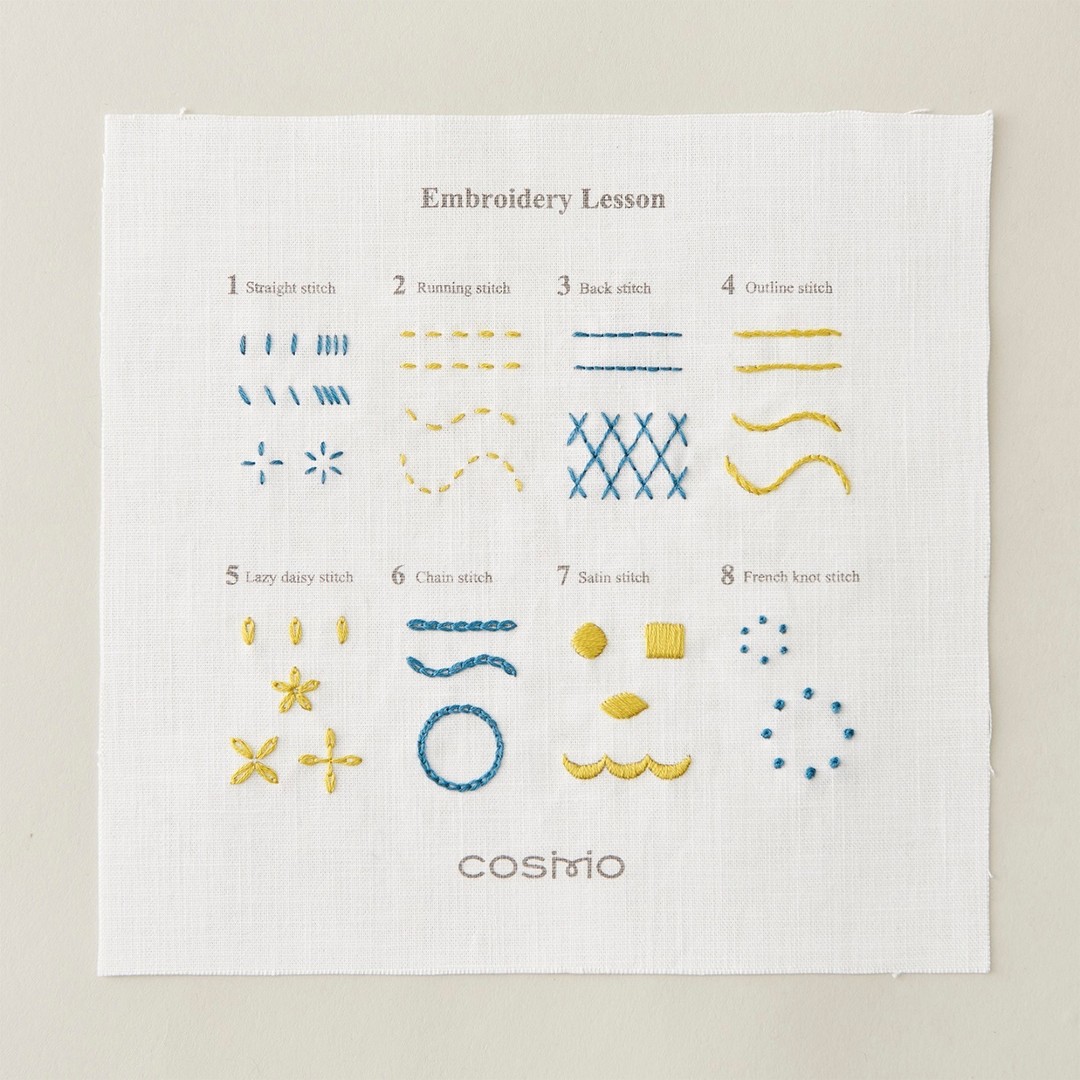
- Straight stitch — short structural lines, rays, or geometric accents; keep lengths even and tension gentle.
- Running stitch — dashed borders and sashiko-like rhythm; equal stitch and space for a calm beat.
- Backstitch — continuous crisp lines for stems, lettering, and outlines; come up one stitch ahead, then go back into the previous end.
- Outline stitch — smooth curves and plant stems; keep the working thread on the same side of the needle for a clean rope-like line.
- Lazy daisy (detached chain) — petals and teardrops; anchor each loop with a tiny stitch and avoid overtightening.
- Chain stitch — borders and textured lines; insert into the exact exit point so loops stay the same size.
- Satin stitch — solid fills with sheen; lay No. 25 strands flat, side by side, without overlap.
- French knot — centers, seeds, and raised dots; wrap once or twice and keep gentle off-hand tension as the needle goes through.
Sampler as Reference
As you fill the lesson cloth, watch how length, spacing, and strand count change the line. That observation becomes your personal library for later projects.
From Sampler to Finished Motif
Layer with intention
Carry the same habits into a small completed piece—a flower on dark cloth in a hoop, or a hand-stitched brooch. Outline for stems, lazy daisy for petals, French knots for centers: the sampler already taught the grammar.
- Structure first — outlines and stems in No. 25 solids
- Petals and fills — lazy daisy, satin, or chain where the design asks
- Accents last — French knots; optional Seasons for soft shifts, or Nishikiito® for a single gleam
- Scale & tension — muscle memory from the sampler keeps small motifs even
Optional: A Cross-Stitch Companion
The same discipline—consistent tension, a small palette, sample before project—transfers to counted work on Aida. A second starter path practices cross-stitch, French knot, and double cross before a tiny floral grid.
Materials & Tools
A short, honest kit is enough for the whole lesson arc.
- COSMO® No. 25 Cotton Floss — extra-long staple cotton; smooth, soft, and easy to separate into strands
- COSMO® Seasons (5000 / 8000 / 9000) — self-shading variegated floss when you are ready for soft gradients
- COSMO® Nishikiito® Metallic Thread — optional shimmer for a single highlight after the solids are clear
- Hoop & needles — 4–6 inch wooden hoop; embroidery needles sized to your cloth
- Lesson cloth — medium-weight cotton or linen for surface practice; Aida when you bridge to counted work
Tips for a Clear Lesson
Good habits on the sampler save time on every motif that follows.
- Limit the first palette to three or four No. 25 solids so stitch structure stays readable.
- Match strand count to the job—fewer strands for fine lines, more for satin fills.
- Press finished pieces from the back on low heat with a cloth if you add Nishikiito® later.
- Keep a photo or the physical sampler nearby; it is faster than relearning a stitch mid-project.
Product Recommendations
Build from solids; add variegation and metallic only when the foundation feels natural.
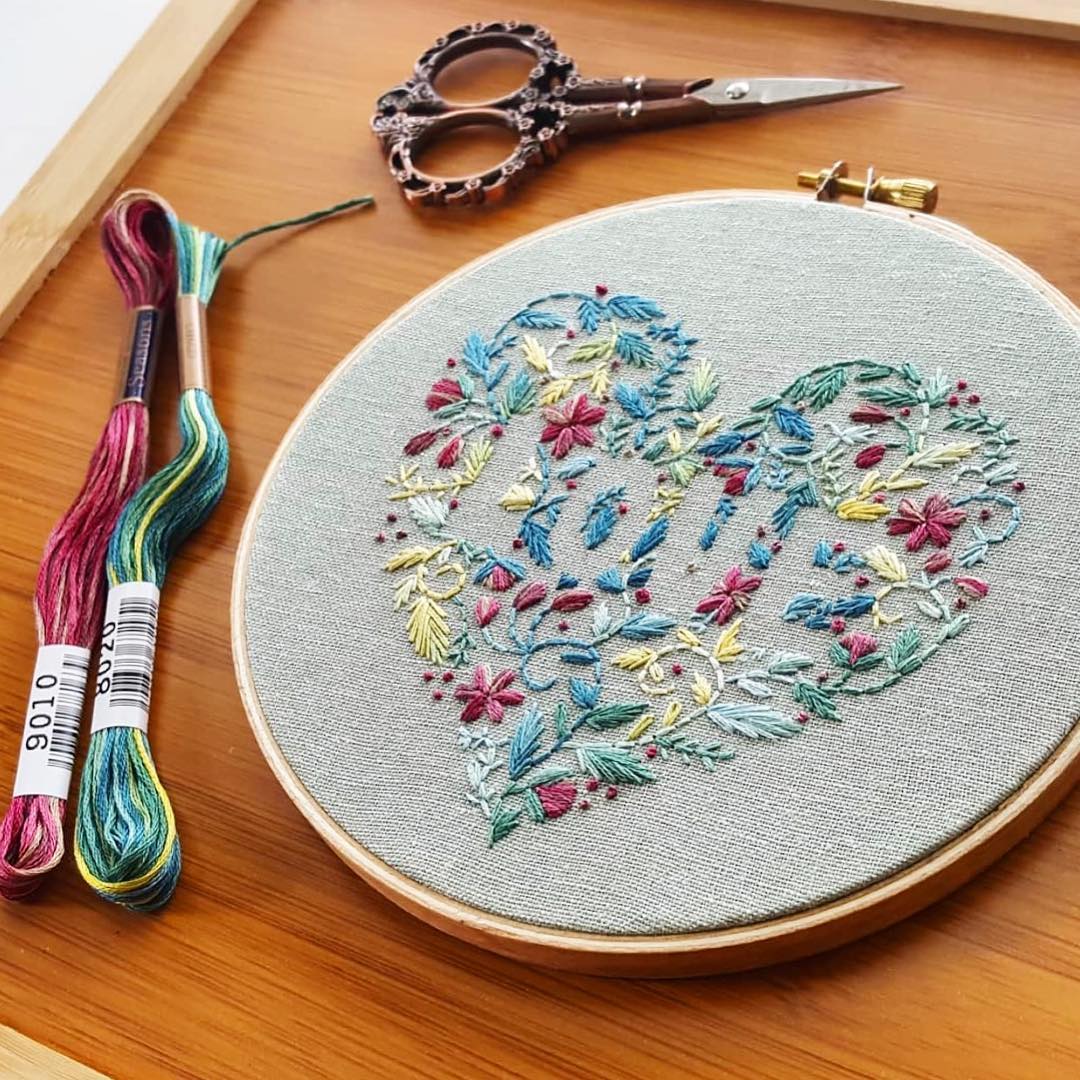
- COSMO® No. 25 Cotton Floss — 500+ solid colors for clear lines, fills, and sampler work.
- COSMO® Seasons Variegated Floss — 140 self-shading colors across series with different change rhythms (5000 / 8000 / 9000).
- COSMO® Nishikiito® Metallic Thread — 33 specialty colors across five finishes for quiet sparkle.
- Starter and lesson kits — sampler cloth, motif fabric, hoop, and needles in one calm set.
Final Note
One lesson, eight stitches, one finished motif. COSMO threads help you build confidence, explore texture, and make something you are proud to display or wear. Master the foundation, and every later project—surface or counted—becomes more intuitive, controlled, and beautiful.